WITH THE FREE PATRONAGE OF

CARNEVALE DI PUTIGNANO

CHURCH OF SAN PIETRO APOSTOLO

CHURCH OF SAN PIETRO APOSTOLO











 Frederick II of Swabia was excommunicated and died in 1250. After him his son Manfredi, following what his father had said in his will, returned Putignano and the territories near the Abbey of Santo Stefano, there was no worse time than this for the territory and for the Putignanesi, in fact, the plague was added to the famine.
In 1317 Putignano and the monastery of Santo Stefano were declared Baliati and entrusted to the Knights of Malta with the title of Balì. The Knights of Malta who became Balì were holders of spiritual and temporal power. The Knights of Malta were friars soldiers obliged to take care of sick pilgrims and to defend Christianity from infidels with weapons.
Between 1086 and 1088 Goffredo d'Altavilla coonte of Conversano, nephew of Robert the Guiscard, cured of a dangerous illness, wanted to dissolve the vow made in Santo Stefano and had a church erected in his place in a place called Torre Paolo a 2 miles away from the sea of Monopoli. He invited the Cistercian Benedictine fathers and to continue and spread the cult of the Saint, he gave them many lands, including the Castle of Putignano. The deed of donation has never reached our times, but the monks had this agreement carved on a plaque still present behind the church altar, as a memorial to posterity. In this way a real struggle for supremacy was established for the territory between the Papacy, the Bishopric and the Abbots, all of whom were sided by as many distinct political powers.
The privileges of the Noble Castle were also approved by Frederick II who promised the construction of the University and another castle near Porta Maggiore or Porta Grande. In 1219, however, it was the Emperor himself who had the walls and the existing castle demolished due to the disobedience of the Putignanesi who, on the advice of the Benedictines, sided by the Pope, closed the doors, while he was about to enter the city, after a hunting party. .
While the city was being destroyed, Frederick II liked and wrote
"Marsupium non sanum dic tu Putineanumfalsa tibi praedicit, cum credibilia dicit
gioia, castrum carum, praedetur Putineanum"
Sacco rotto, chiama tu Putignano, ti dice il falso quando annuncia cose credibli, Gioia, Castello a me fedele, saccheggi Putignano
L'Imperatore era adirato con i putignanesi che credevano alle dicerie di scomunica e non riconoscevano la sua autorità.
Ma il suo segretario Pier delle Vigne, invece cerca di discolpare i Putignanesi, intravedendo un segnale alternativo, egli così scrive:
"Mancipium Romanum est castrum Putineanum
diva tibi praedicit, quando anathemata dicit,
Gioia, silva canum, absit vincat Putineanum"
Tenacemente ossequiente a Roma, è il castello di Putignano,
ti annunzia cose divine quando ti da l'anatema,
Gioia, selva dei cani, lungi sia che vinca Putignano.
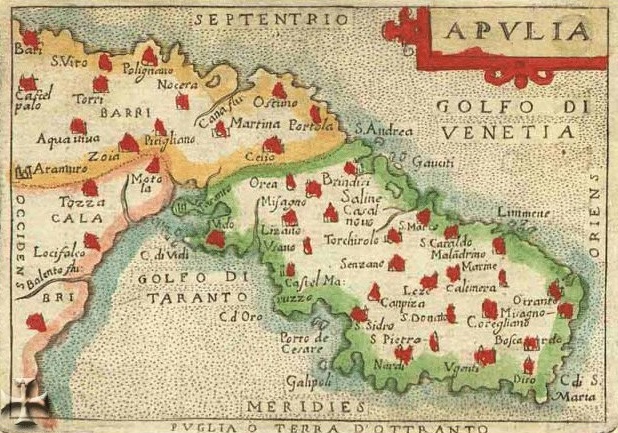 Thanks to the numerous finds of coins, shards, vases and weapons found in the sepulchres within and outside the walls of the village it has been possible to understand the age of the country that most likely dates back to the earliest Greek settlements. Currently, dialects of the ancient Greek dialect are still used in local dialect formulas.
In Christian rituality, some symbologies from Greek mythology have also been retained, such as the ascension of Jesus to heaven, which is recalled in the city, with mint branches and first fruits (a clear reference to the myth of Proserpine: it is said that Proserpina seeing Pluto infatuated from the mortal Mentha, infuriated, he transformed her from a budding young girl, giving her a strongly sedative scent.
Another denotative element is represented by the caves that characterize this territory, hypogeums probably inhabited in prehistoric times. Going back to historical documents it was once called Castrum, but Leandro Alberti in a detailed description of 1581 in his "Description of the whole of Italy" calls it Nobilissimo Castello. In the early days of urban settlement, the circumference measured 150 steps, about 225 meters and in 1442 it counted 106 families.
In 1700 the circumference went up to 500 steps, or 750 meters and the families became 1500, there were about 7000 inhabitants. It was considered the eighth city of the kingdom of Naples, in size and population. Unfortunately, the ancient walls and towers were plots and the moats filled for the construction in 1876 of the Estramurale. The ancient buildings that enriched the town have almost completely disappeared, only in some ravines it is still possible to see some precious remains victoriously resisted by time and by the neglect of man, many fortunately recognized as national monuments in 1905.
 It is composed of a Sannitic shield, surmounted by a royal crown with five gold points. At the bottom of the shield we find the three green mountains with the highest central one, built by Frederick II, of Hohenstufen, who was so fond of the city. Frederick II also wanted the stars to shine with ever greater glory. The royal crown was inserted to make it famous among all the deserving Universities, or as it was called the Town Hall or Municipality before the XVIII century. The mountains indicate firmness to stability in the devotion to him.
All this information comes from a rescript of the Emperor Charles V of January 1536, preserved in the municipal archive, in this document there is the addition of a booklet on the top of the central mountain which was, however, eliminated on March 29th 1600 for resolution of the same University.
DELIBERA OF MARCH 29, 1600 WITH WHICH THE P OF THE PUTIGNAN STEM WAS REMOVED

A 29 Marzo 1600, congregatis infrascritti Sindaco ed Eletti deputati ad regimen dittae Terrae, pro infrascriptis negotiis, coram Gubernatore eiusdem terrae, in domibus ipsius Universitatis, loco solito, Pietro Paolo de Pinto Sindaco, Pietro Antonio Pugliese, Venturino Campanella, Iacobo Calefato, Prospero Spirito, Notar Simone Fanelli, Antonio Desimone, Giliberto de Pinto, Lorito de Pinto, Vincenzo Mezzapesa, Giambattista de Paolo, Antonio Bongiorno; fu pari voto conchiuso, che per essere tutti consumati li tre Stendardi che servono alla Fiera di S. Angelo e non essendo rimasto altro che li bastoni, che detti tre Stendardi s’abbiano a fare in Napoli, novi e se abbiano a fare quanto prima, acciò se possano trovare a tempo alli 8 di Maggio quando si fa detta Fiera, e mandarsi i danari; e poiché nell’arma dell’Università ci è un P in mezzo sopra li tre Monti, con due Stelle sopra i due Monti, s’abbia a levare, restando i tre Monti, con due stelle sopra i due Monti (laterali), ed al Monte di mezzo la Corona e così abbia a far l’Arma allo Stendardo.
 This website project born from the idea of Gianni Musaio is enclosed in a team spirit and is the result of the collaboration of people, ordinary citizens, who care about the historical, cultural, artistic, geographical, food and wine heritage of the historic center of Putignano, a town in to live.

The historic center of a town is the fulcrum of the territory, where ancient stories, traditions and culture of those who preceded us are preserved. You too can contribute to leaving the testimonies of the past to the generations to come, taking care of them.